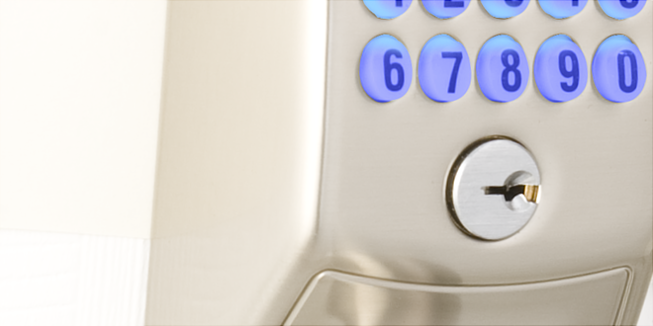
No, you do not have to buy new locks to lock a person with a key out. You can
have the locks rekeyed. A rekey is the removal of the small pins within your
lock that match the old key, and the installing of new pins to match a new key.
The cost of rekeying your locks is much less then the cost to replace your
locks.
Yes, we do offer keys that will prevent unauthorized key duplication. You must
use a restricted key to prevent unauthorized key duplication. Restricted keys
may be mechanical, electronic or a combination of both. A key that has been
stamped with the words do not duplicate may not be a restricted key. A lack of
key control is the largest cause of unauthorized entry without the use of force.
Yes, most safes have the ability to have the combination changed. Over the past
few years advanced electronics have made it much faster and easier to the change
the combination on an electronic safe. A mechanical safe may have to be
disassembled to change the combination. Most safes require the safe to be open
and the old combination known. It is very important to insure the safe is
working properly with new combination before relocking the safe. If a
combination is not working properly do not close the safe and lock it.
The difference between a fire safe and a burglar safe is straightforward. A fire
safe keeps items safe from a fire and a burglar safe keeps items safe from a
burglar. A fire safe is designed for the protection of paper items. If film or
media is to be protected it must be kept in a media safe due to it's lower
temperature destruction properties . A safe can also be both burglar and fire
rated. A burglar rating on a safe usually only is for the safe door unless
otherwise specified.
Most lock cylinders both old and new use a shear line process to unlock.
Although many factors play a role in how easy a lock is to pick open. most locks
can be easily opened with a picking device. When two or more processes are
needed to allow the lock to open it becomes virtually pick proof. It is very
important to insure you have at least two different factors that must be meet to
unlock a cylinder if you are wanting an extremely pick resistant lock. The level
of pick resistance will increase with every different factor implemented.
Yes, an access control system can lock out users at different times even if a
person must use a code or card type device to enter. It is impotent to know that
not all access control systems have this capability. The more options you add to
an access control system will increase the cost of the system. Many access
control systems must be a balance between options and cost. A access control
system is designed for particular procuress and not all are alike. determine the
needs you have, but also think of the ability to upgrade or add to the system.
It is extremely important to maintain control of all the codes, keys, cards,
tags, ID's and fob's of an access control system for it to be effective. Remove
users immediately when they no longer have access privileges.
Abbreviations and definitions used in conjunction with physical security.
ACTION The arrangements of live or latch bolts and their accessories in a lock
or latch, and how they function.
ALIKE CHANGE More than one lock or latch which can be operated by the same key.
ALL TO PASS Often referred to as "locks to pass" i.e. a number of locks which
can be passed or keyed alike (opened by the same key).
ANTI-THRUST BOLT A spring bolt, for a night latch particularly, which cannot be
pushed back when it has shot out and fastened a door.
ANTI-THRUST PLATE An overlapping metal plate fitted to outward opening doors so
as to prevent access to lock bolts.
AUTOMATIC DEADLATCH A deadlatch, the main bolt of which is automatically locked
(or deadlocked) when the door is closed.
BACKPLATE The plate, fixed on a door, to which the moving parts of a lock or
latch are attached.
BAR (OF LEVER) The part between the pockets which is slotted to allow the bolt
stump to pass through.
BARREL AND CURTAIN This is the full name of a security device fitted in some
locks to turn and close the keyhole when the key or any other instruments
inserted through the keyhole is turned.
BARREL BOLT The common kind of door bolt having a round shoot running in a long
continuous guide or strap attached to the backplate, the shoot being provided
with a knob or the equivalent for operation by hand.
BATHROOM LOCK A lock with a springbolt operable on both sides by furniture, and
a deadbolt operable from the inside only, usually by thumb turn.
BIRMINGHAM BAR A steel bar fitted to the inside face of a door frame on the
hinge side.
BOLT The part of a lock or latch which provides the fastening or engagement by
protruding from the case or forend to engage in the staple, striking plate,
link, shackle or other member.
BOLT HEAD The portion of a bolt that protrudes beyond the case of forend of a
lock.
BOLT HOLE The hole in a case, forend, plate or staple to guide and/or admit the
bolt.
BOLT STUMP According to some authorities, this is the name of the part that upstands, usually rectangular in section, on a dead bolt or runner which passes
through the slot or gating in the levers as the bolt moves.
BURGLAR BARS Steel bars, usually round or square in profile, cut to length and
fixed internally to window frames.
CABINET LOCK A generic term to include all locks of any type for use on pieces
of furniture, such as cupboards, drawers, chests, boxes and the like.
CAM Usually a tongue fixed to the end of the plug of a cylinder lock or latch.
CAM LOCK A complete locking assembly in the form of a cylinder whose cam is the
actual locking bolt.
CAP (OF THE LOCK) The removable cover to a lock mechanism.
CASE That part of a lock or latch containing the mechanism.
CASEMENT DOOR A hinged door or pair of doors almost wholly glazed; often called
a French Window.
CASEMENT WINDOW A window in which one or more lights are hinged to open.
CHAMBER The holes in cylinder housings that house top pins (drivers) and
springs.
CHANGE KEY The key which opens one particular lock, the term is usually used
with Master-Keyed Suites (Servant key).
CHANGE KEY LOCKS These are locks which can be operated by any key chosen from a
large number of different keys that have been made for the purpose. The selected
key is the only one which will open the lock until a change is deliberately
made.
CLAW BLOT A type of deadbolt having pivoted claws which swing out sideways when
the bolt is shot. Such locks are usually fixed to sliding doors.
CLUTCH HEADED SCREW Threaded screws suitable for wood or metal with a shaped
head allowing clockwise action to fix but no anticlockwise action to remove.
CLOSE SHACKLE PADLOCK A padlock, the body of which is built up so that the
minimum amount of shackle is visible when locked. It offers improved security
against forcing or use of bolt-croppers.
COLLAR The shoulder on the shank of a rim, mortice or bitted key, controlling
the point at which the key comes to rest after being fully inserted into the
lock. The collar is the datum point from which the key is measured.
COMBINATION LOCK An abbreviation of name for a keyless combination lock.
CONCEALED FIXING (OF LOCKS OR LATCHES) A strong backplate is screwed to the
door, the lock case slides over it and is secured in position by two or more
grub screws which are concealed whenever the door is closed. This is usually
associated with security night-latches.
COVER The part of a lock or latch which covers the mechanism and is fixed,
usually by screwing, to the case.
CROSS DIFFER An error situation whereby change keys (servant keys) operate more
than one lock when this was not intended.
CROSS RAIL The horizontal member of a door.
CUT CABINET LOCK A cupboard or drawer lock, the flange of which is recessed into
the edge of the drawer or door.
CURTAIN An abbreviation for barrel and curtain.
CYLINDER Usually the cylinder with inner co-axial plug which houses the pins,
top pins (drivers), or disc tumblers and springs in the cylinder body.
CYLINDER HOUSING With all component parts removed, this forms the main body or
housing of a cylinder.
CYLINDER KEY A key, having a bow and long blade in which Vee cuts are made along
the upper edge to operate the pins and drivers in a pin tumbler mechanism.
CYLINDER LOCK OR LATCH Any lock or latch, the mechanism of which is contained in
a cylinder.
CYLINDER ROSE (OR RING) A shaped metal disc which surrounds the outer face of
the cylinder of a cylinder mechanism assembly. It usually stands slightly proud
of the outside face of door.
DEADBOLT The square-ended bolt of a lock which is moved in both the locking and
unlocking directions by the key (but occasionally by thumb turn inside only) to
provide fastening.
DEADLOCK A lock having only a square-ended deadbolt operable from one or both
sides by key, and occasionally from outside only by key, inside by thumb turn.
Sometimes operable only from outside and with no inside keyhole, which is
designated a single-entry deadlock.
DIFFERS An abbreviation of "different combinations" or changes.
DISC TUMBLER LOCK A cylinder lock having disc instead of pin tumblers.
DOOR CLOSER A devise for closing a door or gate automatically after opening.
There are numerous types available.
DOOR VIEWER Optical device fitted through a door to enable observation without
opening the door.
DOUBLE BITTED KEY One with a bit on each side of the shank.
DOUBLE FEATHER SPRING Two separate feather springs, fitting closely together one
inside the other. Alternatively both may be made form one length of material and
remain joined at one end. A spring so made is more lively and likely to last
longer than a single spring of thicker material.
DOUBLE LOCKING 1. By introducing a different cam arrangement into the action of
a cylinder rim nightlatch it is possible to give a double or deadlocking
facility at no extra cost. A simple opposite turn of the key in the outside
cylinder deadlocks both bolt and inside knob simultaneously. This gives
protection against the bolt-forcing and the glass or wood panel breaking
intruder.
2. Also where a lever lock shoots its bolt by more than one turn of the key,
thus doubling the distance of its shoot.
DRILLED-THROUGH SPINDLE (FOR LOCK FURNITURE) Usually shortened to DT. A spindle
with a few holes drilled at each end, one of which accepts the screw passing
through the neck of the knob (or lever handle) in the door furniture.
DRILLPIN (SOMETIMES PIN) A fixed stump or pin in a lock onto which the hollow
shank of a pipe key fits when inserted to operate the lock.
DRIVERS (TOP PINS) Pins that rest outside the plug of a cylinder when the key
has created the shear line and are housed in the chambers of the cylinder
housing. Drivers can be of various shapes other than cylindrical, so as to form
anti-rap pins or anti-pick pins. See "Mushroom Drivers".
DROP 1. In drawer, chest, box or similar cabinet locks, the vertical distance
from the outside face of the top edge or selvage to the centre of the keyhole.
2. Sometimes this term is used for a keyhole cover an a padlock.
EAR OF KEY OR SHOULDER The projecting stop on one or both edges of a pin tumbler
or other key near the bow to prevent the key from being pushed too far into the
lock.
EASY ACTION A lock is designed so that only light spring pressure is required to
move the bolt ; additional spring pressure is required to move the follower and
lock furniture. This is necessary especially when lock furniture comprises of
lever handles, the handles then return to their correct position.
EN SUITE To indicate that locks are incorporated in a master keyed system or
keyed alike en-suite.
ESCUTCHEON The cover for the key hole of a mortice or similar lock.
FACE PLATE The outer of a double forend. A strip of metal fixed to the inner
forend, thus forming a double forend.
FALSE NOTCHES OR FALSE GATING 1.The notches in the bar of the levers and the
bolt stump of some locks to improve the security against attempted picking.
2. Cuts or notches which are put in some keys to give the appearance of greater
intricacy although they serve no useful purpose.
FINAL EXIT DOOR The exit door through which entry must later be obtained, and so
cannot be bolted. It is usually the front entrance door or final means of
exiting.
FLAT STEEL KEY A key made from steel sheet or strip, without corrugations in the
thickness, but having the edge(s) notched to provide the differs.
FLUSH BOLT A door which can be recessed flush into the edge or face of a door.
FOLLOWER That part of the latchbolt or springbolt mechanism containing a square
hole to admit the spindle (to which furniture is attached) which withdraws the
springbolt when turned. It has one or two projections or horns which act on the
bolt foot.
FOREND That part of the lock or latch through which the bolt(s) protrude, and by
which the lock or latch is fixed to the door.
FOUR-WAY LOCK A rim lock so made that it can be fitted as either a right hand or
left hand installation on doors opening either inwards or outwards, without
alteration, except that in some types the springbolt may need reversing.
FULL REBATED (LOCK OR FOREND) A mortice lock or latch with a specially shaped
forend and striking plate to suit the shaped meeting edge of a single door which
overlaps the door frame or a pair of doors which overlap each other - and such
overlap or rebate is at the centre of the door thickness.
FULL WIDTH PADBAR Usually purpose made, a steel bar spanning the full width
opening of a door with supporting brackets or staples fixed to the frame and
secured by a padlock.
FURNITURE The additional items needed, which are screwed to one or both sides of
the door to enable a lock or latch to be manually operated.
GRAND MASTER KEY When a series of locks is divided into two or more sub-suites
the key which controls all the sub-suites (i.e. all the locks in the entire
complex) is called the grand master key.
GREAT GRAND MASTER Key One higher in degree than a grand master key. It is used
only in very special arrangements of master keyed locks.
GUARDS A guard is a fixed part inside a lock to prevent false keys from turning,
or to prevent an instrument from reaching the bolt or levers.
GUNMETAL Another term for bronze.
HASP AND STAPLE A fastening in two pieces for a door or box to be secured by a
padlock. The hinged part is called the hasp and shuts over the staple. For real
security it is essential to use a hasp and staple with concealed fixing.
HINGE BOLTS Fixed steel protrusions fitted into the rear edge or hinge side of
doors, closing into holes cut into the door frame, to protect from forced attack
on the hinge side of the door.
HOLD BACK STOP A thumb slide on the case of a cylinder rim nightlatch or in the
forend of a cylinder mortice lock used either to hold back or alternatively
deadlock the main bolt.
HOOK BOLT A pivoted springbolt, the head of which is shaped in the form of a
hook. Such locks or latches are usually fixed on sliding doors.
HOOKWARD KEY The ward is fixed in the lock case formed as part of a circle like
a wheel ward, but with a return or flange so that a cut in the key to fit would
be L shape.
HORIZONTAL LOCK A mortice or rim lock having the follower hole further from the
forend than the keyhole, but in the same horizontal plane. Used when knob
furniture is specified to prevent the barking of knuckles on the door frame.
IMITATION BMA An electro deposited powder or lacquer finish on metal to simulate
as nearly as possible the genuine Bronze Metal Antique finish. It is known as
lBMA.
JAMB The vertical member of a door or window frame. In some areas the top rail
of a door frame is referred to as the top jamb.
KEEP OR KEEPER A term sometimes used, particularly in the North, for a staple or
striking plate.
KEY CHANGE A term sometimes used instead of "differ". The change or differ of
the key is generally indicated by number, and sometimes numbers and letters
marked an the bow.
KEY STEPS OR KEY DEPTHS This term usually means the bolt step and lever steps of
a key for a lever lock.
LATCH The type of product with one bolt only.
LATCHSET A latch complete with necessary furniture including a spindle, ready
for fixing to the door.
LEVER A flat shaped movable detainer in a lock, usually for the purpose of
providing security and differs.
LEVER MECHANISM A lock mechanism having, as its principle feature, one or more
levers.
LEVER HANDLE A piece of lock or latch furniture, usually on a rose or plate, for
use as an alternative to a knob for operating the springbolt of a lock or latch.
All British lever handles are spring-loaded to ensure the return to horizontal
after use.
LEVER PIVOT The stump in a lock on which the levers swing.
LINK PLATE The complementary member of box, desk and other locks which is fixed
to the lid or some part of a cabinet, for example, and has one or more
projecting links to enter the lock and engage the bolt.
LIP (OF STRIKING PLATE) The projection on one side of a striking plate on the
surface of which the springbolt of the lock or latch first strikes when the door
is closed.
LOCKABLE BOLT A bolt that can be shot and locked in position by the use of a
removable key.
LOCKING LATCH A latch with a bevelled springbolt or roller bolt which is capable
of being lacked or secured, usually by key.
LOCKSET A lock complete with necessary furniture including a spindle, ready for
fixing to the door.
LONDON STRIP A steel bar fitted to the inside face of a door frame, shaped to
accommodate the staple or striker of a rim latch lock
LONG SHACKLE (LS) A padlock shackle with a greater amount of clearance than the
normal standard shackle.
LUBRICATION On no account should oil be used to lubricate pin-tumbler cylinders.
Graphite is the conventional lubricant for this mechanism.
MASTER KEY A key which will open every lock in the master keyed suite.
MASTER KEYED (LOCKS OR LATCHES) A lock or latch capable of being operated also
by a master key as well as its own change or servant key.
MASTER PINS Small pins sometimes called wafers to build up chamber pin loading
in pin tumbler master keyed cylinders.
MECHANISM (OF LOCKS OR LATCHES) The arrangement of the component parts and the
manner in which they perform to achieve the required security and differing when
operated by its key.
MORTICE A hole cut into the thickness of one edge of a door to receive a mortice
lock or latch.
MORTICE LOCK (OR LATCH) A lock or latch which is morticed to let into the
thickness of the door from the meeting edge and held in position by screws
through the forend.
NARROW CASE LOCK OR LATCH A rim lock or latch, the case of which is made
specially narrow, usually less than three inches wide, for fixing to the narrow
stile of a panelled or flush door.
NIGHTLATCH A rim or mortice latch with a bevelled springbolt or roller bolt
which shoots when the door is closed, but can be withdrawn by key from outside
and by knob or lever handle from inside.
NOZZLE A circular boss or ferrule containing the keyhole on some cabinet locks,
including locker locks. Correctly relating to lever cabinet locks.
ONE-SIDED LOCK (SINGLE-ENTRY) A lock which has a keyhole on one side only.
ONE-WAY ACTION An action where the follower will turn only one way.
PAN The removable mechanism chamber attached to the inside face of a safe door.
PANEL GRILLES Steel grilles made to size with various infills of expanded
diamond mesh, square weldmesh or fancy infills, usually fitted internally.
PEG WARD A combination of wards resembling a sash ward but fixed by pegs to the
lock case.
PIN TUMBLER MECHANISM The mechanism incorporated in the cylinder or body of a
cylinder pin tumbler lock, latch or padlock.
PINS Usually the lower of each pair of tumblers in the pin tumbler cylinder
mechanism. The upper are known as drivers.
PIPE KEY A key with a flat bit and a hollow circular shank to locate on the drillpin. Used only on one-sided locks.
PLUG The part of the pin-tumbler cylinder mechanism or disc tumbler cylinder
mechanism into which the key enters and which the key turns.
RACK BOLT A bolt, usually a door bolt, which is toothed so that it may be
operated by a pinion.
RADIUSED FOREND A lock forend which is shaped radically, for use on one of a
pair of swing doors.
REBATE The measurement of the stepped reduction or recess in theforend of a
rebated lock.
REBATED (LOCK OR LATCH) A morticelock or latch with a forend specially shaped to
correspond with the shaped meeting edge of the door for which it is intended.
See "Full Rebated".
RELEASE A striker in Various forms to replace the lock strike and is operated
electronically.
RELOCKER A locking mechanism independent of any key operations, mounted remotely
within a safe mechanism so as to relock the boltwork under certain forced
attacks.
REPEAT DIFFERS That supply of differs which have been issued previously. This is
usually associated with master keyed suites and where a replacement lock is
required to have the same differ as the original.
REVERSED BOLT (RB) A springbolt which has been turned round in its case to suit
a door opening outwards instead of inwards. Great care should be taken to use
this term RB only when ordering items which are required with the springbolt
reversed.
RIGID GRILLES Heavy duty, welded construction, rod or bar grilles, usually
fitted externally or internally to the fabric of a building.
RIM CYLINDER This relates to a pack which usually comprises the cylinder with
plug, rose, connecting bar, two connecting screws and two keys.
RIM LOCK OR LATCH A lock or latch that is fitted by screwing on to the inside
face of the door.
ROLLER BOLT A springbolt made in the form of a roller, instead of being bevelled.
It is recommended far more silent and easier closing of a door.
ROSE 1. A cylinder rose or ring in cylinder locks or latches.
2. In door furniture, it is the small plate to which the lever handle or knob is
affixed and which is screwed to the door surface.
SAFE LOCK A general term for the many varieties of key operated and other locks
for safes.
SASH LOCK An upright mortice lock, consisting of a latch bolt and a key operated
bolt.
SASH WARD Used in rim and mortic elocks, alone or in conjunction with levels for
the purpose of obtaining or increasing the differs.
SCOTCH SPRING LOCK A two-bolt rim lock with the reversible springbolt above or
below the horizontal plane of the follower.
SERVANT KEY The change key of one (or more than one if of the same change) lock
in a master keyed or grand master keyed suite.
SET SCREW One which tightens or fastens another part after assembly or
adjustment.
SHACKLE The hinged, sliding or swivelling loop shaped member of a padlock.
SHANK (OF KEY) The part of a pin or pipe key between the bow and the end,
excluding the blade.
SHOOT (OF BOLT) The distance a springbolt moves under the action of its spring.
SHOULDER (OR BOW STOP) The projectian or ear of shape that controls the point at
which a cylinder or disk tumbler comes to rest when fully inserted into the
lock. It is the datum point from which spacing cuts are measured.
SIDE BAR This is in addition to the existing pin or disc mechanism, and is a bar
usually along the length of the mechanism and does not allow rotation until the
mechanism is correctly lifted and can be directly controlled by the key.
SIDE WARDS Notches cut into the sides of bitted keys so fashioned to enable the
key to turn.
SKELETON KEY A key, the blade of which has been cut away sufficiently to allow
the blade to pass any wards or obstructions within the lock and throw or retract
the bolt. There is no universal skeleton key. One haste be prepared for each
series at warded locks. Skeleton keys cannot be made for lever and cylinder lock
mechanisms.
SLIDING GRILLES Steel sliding grille gates in single or double leaf, running on
top and bottom guide tracks, locked by padlock or integral lock.
SLIDING LEVER A Lever which slides between or on guides instead of swinging on a
pivot.
SPINDLE That part of the door furniture usually of square section which passes
through the follower hole and is fitted to the knob(s) or lever handle(s) to
operate the springbolt.
SPOON The flattened end of a padlock shackle containing the bolt hole or slot
which the bolt enters.
SPACER A distance piece of thin metal placed between the levers of some locks.
SPACING The term used to describe the horizontal distances across a key blade or
bit.
SPIRAL SPRING 1. A spring made of wire to approximately V shape like a feather
spring; with one or more coils formed at the apex of the V to fit over a stump
in the lock case.
SPRING-LOADED Moved under the control of, or against the pull of, a spring fixed
at one end.
SPRING SHACKLE PADLOCK A padlock, the shackle of which springs open when
unlocked, and is locked by snapping to.
SPRINGBOLT Sometimes called the latchbolt. A bolt having the outer edge shaped
by bevelling of the vertical face. It is a bolt which may be pushed back into
the lock-case and will return to the extended position without mechanical
assistance.
SPRINGLATCH A latch with one bevelled springbolt which locks the door when shut.
It is opened by key from the outside and by knob from inside.
STEEL LINING Steel sheet linings applied to external or both faces of a door,
usually screwed and bolted through.
STILE A vertical member of a door.
STOP KNOB (SNIB) A device incorporated in some latches and locking latches to
hold the bolt retracted or deadlock the bolt when door is closed.
STOP BUTTON(S) There are generally two in number. They are incorporated in the forend of certain cylinder mortice nightlatches or locks. One button, when
depressed, renders the outside furniture inoperable and the other, when
depressed, restores the power of operation. They are useful for privacy and on
vestibule doors. They are sometimes referred to as "stopworks".
STRAIGHT CABINET LOCK A cabinet lock, with no flange on the case, for flush
fitting to cupboards and drawers.
STRIKING PLATE Sometimes referred to as a "striker". It is a shaped flat metal
plate fixed to the door frame or jamb with one or more bolt holes into which the
bait or bolts shoot. There is a shaped projecting lip on one side to guide the springbolt., It is used with all mortice locks or latches, and with rim locks or
latches with reversed springbalt on an outward opening door.
SUB GRAND MASTER KEY A key which will operate all locks in its own main group or
(sub-grand suite) of a grand master keyed system.
SUB MASTER KEY A key which will operate all locks in its own smaller group (or
sub-suite) of a grand master keyed system.
SUITE (OF LOCKS) A group or collection locks and/or locking latches and padlocks
of different types and changes incorporated together under a master key or grand
master key.
TALON The gap that is formed by two curves to the radius of the bolt step of the
key in a deadbolt lathe or runner of a lever lock where the key engages the
bolt.
THROW The distance a deadbolt moves under the action of its key.
THUMB TURN A small fitting, on the inside of a mortice lock, which is gripped
between thumb and finger to operate the deadbalt. It should not be used on
glass-or wood-panelled doors.
TILL LOCK A drawer lock, or more correctly a cabinet lock, having a springbolt
that shoots upwards and a vertical keyhole. It is self-closing and is unlocked
by key.
TIME LOCK A clockwork or electric timing device which disallows operation of a
lock or the opening of a door on safes or strongrooms.
TUMBLER A movable detainer which must be lifted before the bolt of a lock can
move.
UPRIGHT LOCK A mortice or rim lock upright in form, of which the case is narrow
and the centres of the follower hole and keyhole are in the same vertical plane.
It is known also as a sashlock.
WARDS Fixed obstructions inside a lock case to preclude the use of wrong key, as
the key is cut to pass over the wards and operate the lock. They are sometimes
used in lever locks to give increased differs. Wards alone give very little
security. See "Skeleton Key".
WARDED LOCK Any lock or padlock, the mechanism of which makes use only of wards.
Not recommended due to lack of security.
If you did not find the answer to your question please E-mail us with your
question. You may see your question added to the F.A.Q. page.
customerservice@carolinalock.com